
Every minute counts. Emergency mechanical thrombectomy removes brain clots — up to 24 hours after onset in selected patients.

A brain stroke is a sudden-onset neurological deficit caused by a disruption of blood supply to part of the brain, leading to sudden loss of function of the affected body parts. It is a leading cause of disability worldwide and a major cause of death. Because brain cells begin to die within minutes of losing their blood supply, a stroke must be treated as an emergency.
Symptoms come on suddenly and can include inability to move an arm or leg, drooping of the mouth to one side, loss or slurring of speech, numbness on one side of the body, and sometimes loss of consciousness.

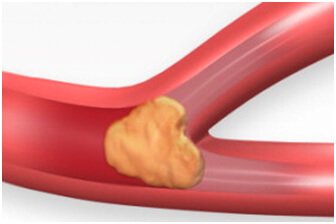
A clot blocks a blood vessel and cuts off blood supply to part of the brain.
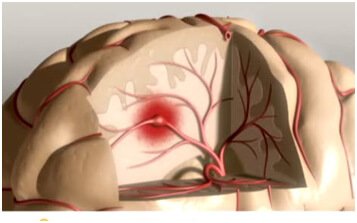
Rupture of a brain blood vessel, usually from hypertension, an aneurysm, or an AVM.
Clot-dissolving medicine (tPA) given within 4.5 hours of onset.
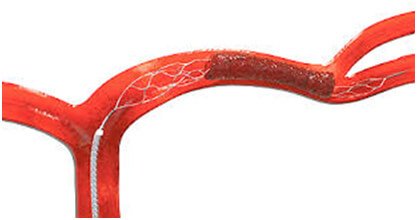
Physical clot removal using stent-retriever or suction devices, up to 24 hours.
Removing the clot within the window allows significant recovery for ischemic strokes.
Controlling blood pressure, smoking, and atrial fibrillation prevents 80% of strokes.
Stroke symptoms come on suddenly: weakness or inability to move an arm or leg on one side, drooping of one side of the mouth, loss or slurring of speech, numbness on one side of the body, and sometimes loss of consciousness. Remember FAST — Face drooping, Arm weakness, Speech difficulty, Time to call for help.
Treat it as an emergency and get the person to a comprehensive stroke centre immediately — do not wait to see if symptoms pass. The faster the blocked vessel is reopened, the more brain can be saved.
A clot-dissolving drug (tPA) can be given through a vein within 4.5 hours of onset. For clots in major brain arteries, mechanical thrombectomy physically removes the clot, and can be performed up to 24 hours from onset in carefully selected patients.
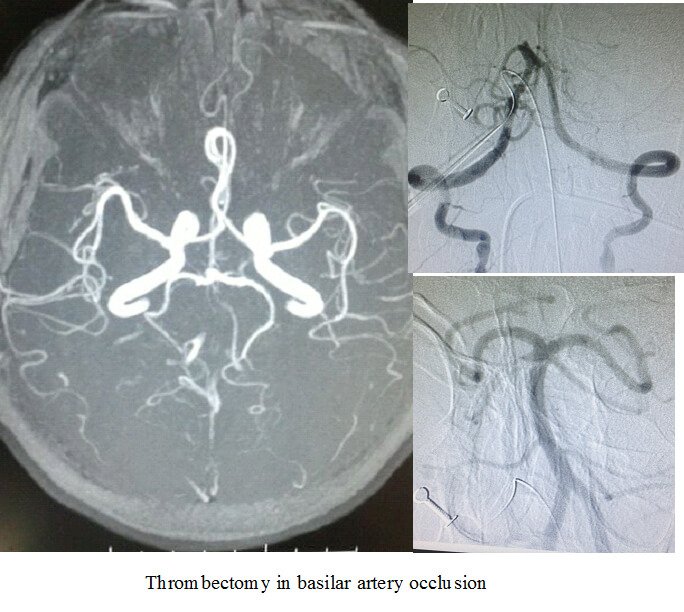
Mechanical thrombectomy is a minimally invasive emergency procedure that removes a clot from a blocked brain artery using a catheter guided from the groin, restoring blood flow.
Clot-dissolving medicine (tPA) is used within 4.5 hours. Mechanical thrombectomy can be performed up to 24 hours from when the patient was last known to be well, in selected patients whose brain scans show salvageable tissue. Earlier treatment always gives better results.
Recovery is possible, especially for ischemic strokes (about 85% of cases) when the clot is removed within the treatment window. The earlier treatment happens, the better the outcome.
About 85% of strokes are ischemic, caused by a clot blocking a brain vessel. The rest are hemorrhagic, caused by a brain vessel bursting, usually from high blood pressure, an aneurysm, or an AVM. An urgent brain scan tells them apart, and their treatments are completely different.
Yes, about 80% of strokes are preventable. Controlling high blood pressure is the most important step, along with stopping smoking and managing atrial fibrillation.
At Neuro & Vascular, acute stroke is treated with emergency mechanical thrombectomy by Dr. Suresh Giragani, Consultant Interventional Radiologist at Apollo Hospitals, Jubilee Hills, Hyderabad, with over 18 years of experience.
Yes. Acute stroke is a round-the-clock emergency, and comprehensive stroke centres are equipped to perform urgent imaging, thrombolysis, and thrombectomy at any hour.
Recovery varies widely depending on the type and severity of the stroke, how quickly treatment was given, and the area of brain affected. Some patients improve dramatically within hours of clot removal, while others need weeks to months of rehabilitation. Earlier treatment generally means faster and more complete recovery.
On arrival, an urgent brain scan (CT or MRI) is done first to determine whether the stroke is ischemic (clot) or hemorrhagic (bleed), because the treatments differ completely. In suitable cases, CT angiography and perfusion imaging are used to locate a large-vessel clot and check for salvageable brain tissue before mechanical thrombectomy.
Call our emergency line immediately — every minute matters. Don't wait.