
Minimally invasive carotid artery stenting — a major, treatable cause of stroke. Performed by Dr. Suresh Giragani.

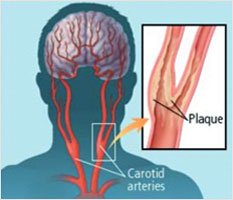
Carotid artery stenosis is a partial blockage of the internal carotid artery, one of the four main arteries (two carotid and two vertebral) that supply blood to the brain. The carotid arteries supply the front part of the brain (the cerebrum), while the vertebral arteries supply the back (the cerebellum and brainstem). When a carotid artery narrows, it can shed small clots or debris that travel upward and block brain vessels — causing a stroke.
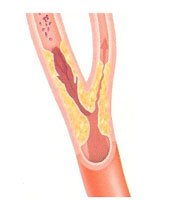
Carotid stenosis is most commonly caused by a fibrofatty layer (atherosclerotic plaque) at the origin of the internal carotid artery. Diabetes, hypertension, high cholesterol, smoking, and family history all contribute to this plaque formation. Very uncommonly, it can occur due to inflammation of the blood vessels (e.g. fibromuscular dysplasia, Takayasu arteritis).
How is carotid stenosis diagnosed? Carotid stenosis is usually first detected with a carotid Doppler ultrasound, which measures both the degree of narrowing and the speed of blood flow. CT angiography (CTA) or MR angiography (MRA) is then used to confirm the findings and plan treatment, and digital subtraction angiography (DSA) provides the most detailed picture when stenting is being considered.
An essential first step, alongside good control of blood sugar and cholesterol.
Aspirin, with or without a second agent like clopidogrel, is the mainstay of medical treatment.
Patients with >70% stenosis and a stroke on the same side should undergo carotid stenting or endarterectomy.
Non-inferior to surgical endarterectomy, per major clinical trials.
Performed through a puncture at the groin or wrist.
A device catches debris during stent placement, reducing stroke risk.
CREST trial: 4-year outcomes 7.2% (stenting) vs 6.8% (surgery) — no significant difference.
No neck incision means most patients return to normal activities within days.
Carotid stenosis is a narrowing of the carotid artery in the neck, the main vessel supplying the front of the brain. It is usually caused by fatty plaque build-up and is a major cause of stroke, accounting for up to 20% of strokes and mini-strokes.
It often has no symptoms until it causes a mini-stroke (TIA) or stroke. Warning signs include sudden one-sided weakness or numbness, sudden difficulty speaking, and sudden loss of vision in one eye. These are medical emergencies needing immediate care.
Patients with severe stenosis (greater than 70%) who have had a minor or major stroke on the same side should undergo carotid revascularisation, either by stenting or surgery. Milder cases are often managed with medication, cholesterol and blood-sugar control, and lifestyle changes.
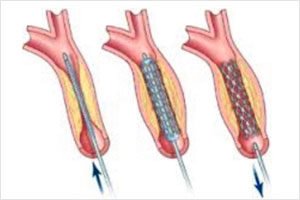
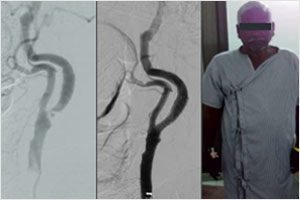
Carotid stenting is a minimally invasive procedure that reopens a narrowed carotid artery by placing a mesh stent inside it, through a small puncture at the groin or wrist. An embolic protection device is used to catch any debris, reducing stroke risk during the procedure. There is no neck incision.
Yes. Carotid stenting has been shown to be non-inferior to surgical endarterectomy. Major trials including CREST found no significant difference between the two in stroke outcomes or recurrence. The choice depends on the patient's anatomy and overall health.
Carotid stenting is a well-established procedure, made safer by embolic protection devices that catch debris during stent placement. As with any vascular procedure there is a small risk, which the interventional radiologist reviews individually. Outcomes depend strongly on operator experience.
Recovery is quick because there is no neck incision. Hospital stay is usually short and most patients return to normal activities within a few days. Dual antiplatelet medication is continued afterwards, with follow-up ultrasound to confirm the artery stays open.
At Neuro & Vascular, carotid stenting is performed by Dr. Suresh Giragani, Consultant Interventional Radiologist at Apollo Hospitals, Jubilee Hills, Hyderabad, with over 18 years of experience in neurovascular and vascular interventions.
Book a consultation with Dr. Giragani, or send your scans and reports for a specialist second opinion.